Vucic presents the "Serbia 2030–2035" plan: No shortages of oil and gas, reserves secured
Foto: Tanjug/Rade Prelić
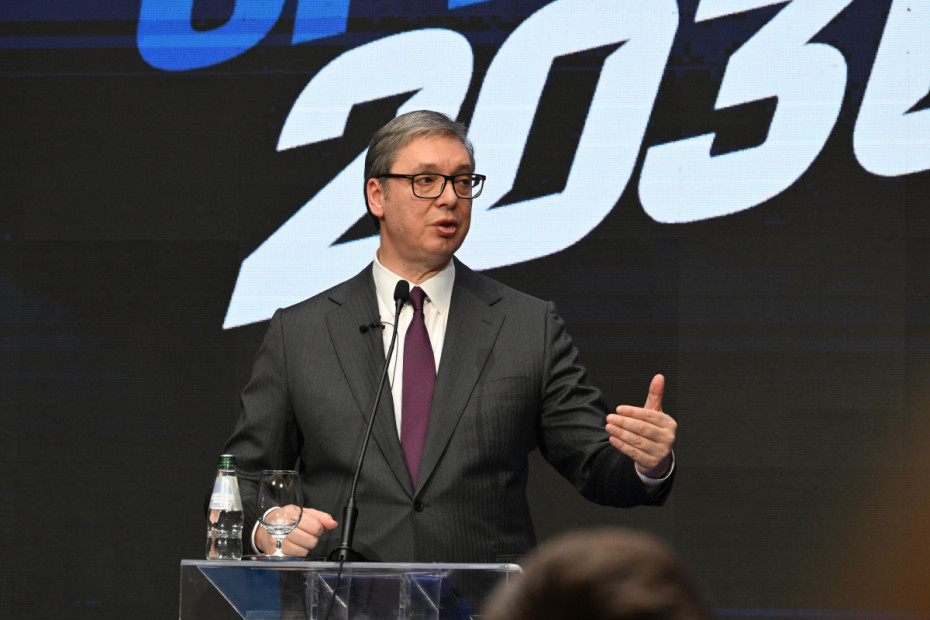
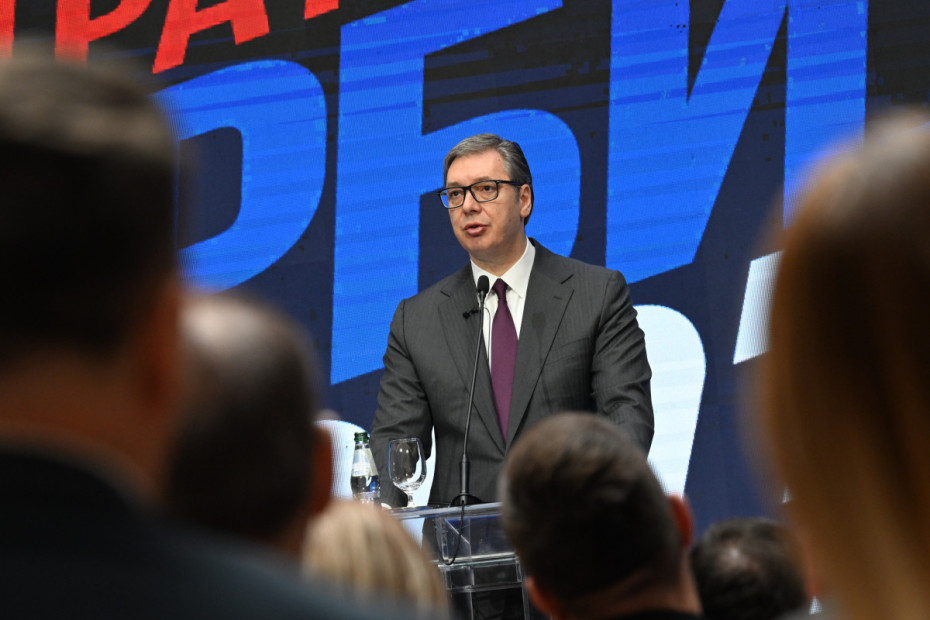
President of Serbia Aleksandar Vucic presented the development strategy "Serbia 2030–2035" emphasizing that the country faces a difficult task of planning for the future in a rapidly changing world.
Newsmax Balkans aplikaciju možete preuzeti sa Google Play i App Store-a.
Vucic stressed that infrastructure and citizens’ quality of life are state priorities, highlighting plans for construction and modernization of roads, highways, railways, as well as water supply and sewage systems across the country.
So far, 622 kilometers of highways and expressways have been built, with another 380 kilometers currently under construction.
Major projects include the "Morava Corridor", the Sremska Raca–Kuzmin section, the Sabac–Loznica expressway, bypasses around Valjevo, Kragujevac, and Novi Sad, as well as the Belgrade–Zrenjanin–Novi Sad route.
Citizens of Serbia, North Macedonia, Bosnia and Herzegovina, Montenegro, and Croatia, who were evacuated from Israel, arrived in Belgrade around two o’clock after midnight on a special Air Serbia flight from Sharm El Sheikh, organized by the Government of Serbia and the Ministry of Foreign Affairs.
Vucic stated that by 2035 the state plans to build an additional 578 kilometers of highways, which together with the existing ones would represent an unprecedented result in Europe relative to the country's size.
The President also announced modernization of 1,019 kilometers of railways, including sections Zemun Polje - Nikola Tesla Airport - National Stadium, Nis - Brestovac, and Nis - Dimitrovgrad, along with a bypass around Nis.
Plans also include smaller airports and expansion of Nis Airport's capacity.
Foto: ATAImages/R.Z.
On water and sewage infrastructure, Vucic noted that most systems are decades old, with water losses in some areas reaching up to 75 percent.
"We must build as many as 30,000 kilometers of new water pipes", he said, pointing to Sabac, where 41 settlements lack water connections, and Kragujevac, where 690 kilometers of sewage networks need renewal or construction.
To solve water supply issues, the state plans investments of €1.5 billion, the largest ever in this sector.
"It’s enormous money, never greater, but still not enough. If possible, we’ll need to allocate even more", Vucic added.
"There will be no oil shortages"
Vucic declared that Serbia will not face shortages of oil or derivatives despite global conflicts. Current reserves include 418,000 tons of diesel (74 days), 94,860 tons of gasoline (71 days), 89,484 tons of fuel oil (159 days), and 16,123 tons of kerosene (31 days for aviation).
Gas reserves in Banatski Dvor and other storage facilities are full, totaling about 550 million cubic meters.
Foto: Tanjug/Amir Hamzagić
From 2028 to 2035, Serbia plans to invest at least €14.4 billion in energy, especially gas power plants, adding one gigawatt of electricity from gas and encouraging private initiatives through public-private partnerships.
Gas pipeline modernization and capacity expansion will be needed to make Serbia a gas transit country. The army will secure key compressor and measuring stations to prevent supply disruptions.
"Progress needed in dual education"
On education, Vucic emphasized the importance of the dual model and the "Kazakh model" of cooperation with foreign universities, opening campuses in Serbia, sending students abroad with return obligations, and purchasing university franchises. He said this would introduce competition and innovation, despite resistance from entrenched interests.
He also spoke about artificial intelligence (AI), predicting productivity increases up to 700 percent, job losses, and global capital redistribution. Only about 15 percent of countries will be ready to integrate AI into education, healthcare, and public administration, and Vucic hopes Serbia will be among them. AI is expected to accelerate healthcare outcomes and autonomous scientific discoveries by 2035.
"229 million euros for natality policy"
Vucic announced €229 million for family support and natality measures, including subsidies for mothers, housing construction after childbirth, rural house grants for youth, an alimony fund, and youth programs.
He highlighted reforms to laws supporting parents of seriously ill children, ensuring monthly payments and social contributions while preventing abuse.
"Around €5 billion for healthcare"
Healthcare spending is about €5 billion annually. Vucic admitted past mistakes in healthcare policy but noted progress in treating rare diseases and funding innovative medicines.
He criticized false claims about "SMS donations" for children’s treatment, saying Serbia compares favorably with developed countries.
He stressed eliminating waiting lists for surgeries and urged citizens to respect hospital schedules.
"Higher pensions and salaries"
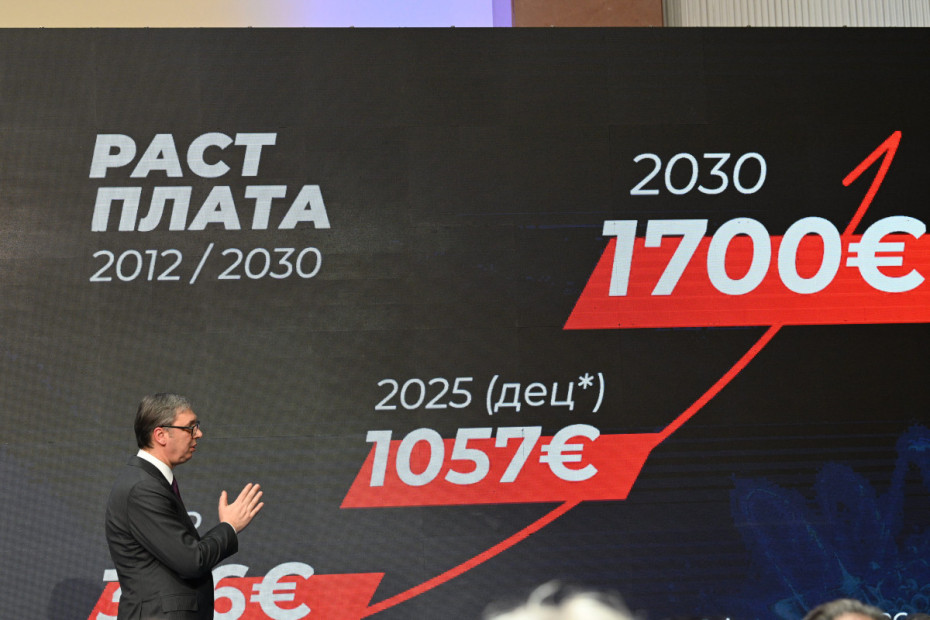
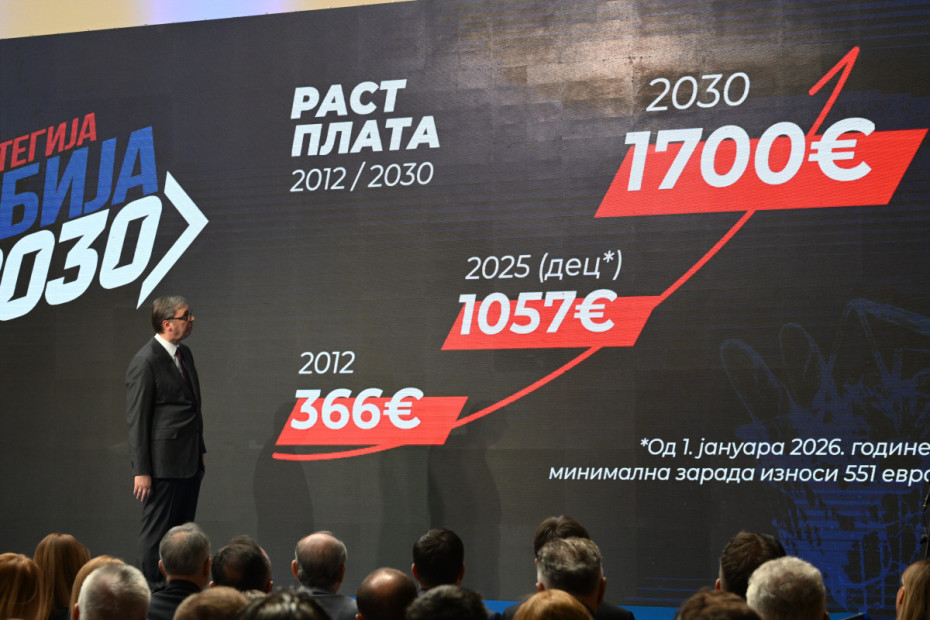
Vucic presented projections of living standards: average salaries rose from €366 in 2012 to €1,057 in December 2025, expected to reach €1,320 in 2030 and €1,700 in 2035. Pensions rose from €204 in 2012 to €484 in 2025, projected at €750 in 2030.
Minimum wages increased from €170 in 2012 to €551, expected to reach €760 by 2030.
"I see Serbia in 2035 as a member of the European Union"
President Aleksandar Vucic emphasized that Serbia is on the path of progress, though not fast enough, and stated that in the future the country will be ahead of others in the region, especially in applying artificial intelligence.
"I see a country that embraces artificial intelligence, the merging of software and hardware, intelligence and labor", Vucic concluded.
Foto: ATAImages/R.Z.
He said he envisions Serbia with a completely different approach to education than today.
"I see Serbia in 2035 as a member of the European Union. Will we have voting rights, a commissioner? I don’t know. But for that we must accelerate our reforms", Vucic stressed.
First goal: preserving peace and stability
At the presentation of the national strategy "Serbia 2030–2035", Vucic underlined that the most important goal in the next decade is maintaining peace and stability.
"The first goal in the next nine or ten years is to preserve peace and stability in the country", he said.
Speaking about internal challenges, Vucic pointed to demographic issues.
"Pro-natality policy is today’s biggest problem. And not because we don’t provide money, everywhere we give the most money, we have the fewest children", he said, citing central Belgrade municipalities as examples.
Foto: Tanjug/Amir Hamzagić
"Our salaries in Vracar and Stari Grad average around €1,700, higher than in Croatia and Slovenia, yet we have the fewest children there. So, the problem isn’t the economy, but our mindset. We must put children ahead of pets, not the other way around", Vucic emphasized.
He added that Serbia must defend its freedom and independence while preserving peace in the region.
"We must not show cowardice, they know we are not cowards, but strategic wisdom: to protect peace and people", he said.
Foto: ATAImages/R.Z.
"We have not changed it under great pressure, and we will not change it in the next ten years", Vucic reiterated Serbia’s policy of military neutrality.
He added that Serbia must strengthen its army and cooperate with various partners.
"We must build good relations with NATO countries, just as we have good relations with Russia and China. Serbia allocates much more than two percent of GDP for the army and police. In the last three months, with what we will sign in seven days, that amounts to more than €6 billion for weapons and equipment", on security investments, Vucic noted.
He stressed Serbia must adhere to international law and be ready to counter threats, recalling attempts to undermine the country’s territorial integrity.
"Opening the first serious drone factory in Serbia"
Vucic announced the opening of Serbia’s first major drone factory with a foreign partner, enabling full production by the end of April.
He highlighted the importance of digitalization and AI in the army and police.
"We must strengthen special units and all services, create units for AI application and a digital army, modeled on Israel. The police sector must adopt this quickly", said Vucic.
"Strategy must not depend on who is in power"
At the start of his speech, Vucic said he would speak differently than usual.
"It is impossible to fully write and prepare such a presentation in written form, due to the amount of data and the enormous changes happening in today’s world", said Vucic.
He explained why the state is presenting development plans up to 2030 and 2035.
"Many people will say it’s because you want to rule until then, because you think about how you will stay in that position. But they don’t understand that strategies, plans, and development programs of a country must not depend on who is in power. Without plans and programs, you are nothing and can achieve nothing. A country’s plan and program of progress are the essence, the foundation, and the basis of its success", Vucic concluded.
President outlines development plan divided into key points
The President stated that the development plan is divided into ten or eleven key areas that will be presented.
"This means we will not present all important sectors or speak about everything. Certain areas will be addressed by members of the executive branch, that is, representatives of the Government of Serbia, in the coming days," Vucic emphasized.
"The world is entering a period of serious conflicts"
He noted that Serbia, along with the entire world, is facing enormous changes and that the next decade will determine the future.
"We live in an era of the greatest and fastest changes in human history. The next ten years will define the future for the next hundred years", Vucic said.
Speaking about challenges society faces, the President stressed that changes in mindset and work are necessary. Serbia must make quick, strategic decisions to keep pace with technological change.
"We must think fast, we must learn and work differently. Otherwise, we will have no chance", Vucic said.
On technological development, he pointed out that only a small number of countries will be fully prepared for the era of artificial intelligence and robotics.
Foto: Tanjug/Rade Prelić
"Only 10 to 15 percent of countries will be completely ready for the arrival of artificial intelligence. These countries will become new powers in the world, while all others will lag behind for the next hundred or two hundred years", he explained.
Vucic also warned of growing global tensions, assessing that the world is entering a period of serious conflicts.
"We live in a time of the beginning of major conflicts. There will be pauses and ceasefires, but this is only the start of a broader wave of conflicts worldwide", he said.
The President cautioned that global conflicts could end with the most severe consequences in history.
"I hope I am wrong, but I fear that the conflicts will end with the heaviest casualties in human history, and that weapons used only once in history may be used again", Vucic warned.
Da li društvo uopšte razume kroz šta žena prolazi posle porođaja i imamo li razvijenu svest od čega je sve treba poštedeti? Znači li postporođajna depresija da žena ne voli svoje dete i kako se izboriti sa postporođajnom tugom? Zašto se od majke očekuje da sve može? Koliko žena u Srbiji prolazi kroz postporođajnu depresiju, a da to nikome ne kaže? Za emisiju “Tražim reč” govore dr Maja Milosavljević Marković psihijatar, patronažna sestra Tamara Obućina, autorka platforme @nisam.samomama Jelena Teofilović, majka devetoro dece Vesna Milićević, direktorka Centra za mamae Jovana Ružičić i osnivačica MAMF konferencije Meliha Žiško.
specijal
11:00
AVANTURA BALKAN
"Avantura Evropa sa Dušanom Radenkovićem" u drugoj epizodi vas vodi kroz prelepu Barselonu, a takmičari će nastaviti svoju trku gde će pobednik osvojiti 5000e. Dušan će im ostavljati tajne tragove kod Sagrada Familije, Kuće Batiljo i čuvene pijace La Bukerije, a takmičarima će zadatak biti da ih pronadju.
dokumentarni
12:00
INFORMATIVNA EMISIJA-PRESEK
Newsmax se bavi temama, a ne pukim prenošenjem informacija. Informišemo, ali želimo i da objasnimo, analiziramo, istražimo. Osvrnućemo se na izazove i prilike s kojima se suočavamo, analizirajući kako se aktuelna dešavanja reflektuju na naš svakodnevni život. Kroz razgovore sa stručnjacima i akterima iz različitih oblasti, pružićemo dublji uvid u važne teme koje se tiču politike, ekonomije, obrazovanja i društvene pravde. Pridružite nam se u ovoj analizi i saznajte više o pitanjima koja su važna za sve nas.
vesti
12:30
NEWSMAX USA-TOP STORY
Prikazuje karusel dnevnih objava i najnovijih vesti, sagledanih iz svih uglova. Spoj popularnih priča i najvažnijih vesti koje ostaju vidiljive danima, često inspirisana glavnim događajem dana ili nedelje.
specijal
13:00
EXPO 2027-SAJAM TURIZMA
Beograd će 2027. godine biti svetska „prestonica igre“: od 15. maja do 15. avgusta – održava se EXPO s temom „Igra(j) za čovečanstvo – Sport i muzika za sve“. Tada će Srbiju pohoditi verovatno najveći broj posetilaca, kojima treba pružiti posebnu turističku ponudu.
dokumentarni
13:30
STAV NEDELJE (R)
Kada se očekuje završetak svih 14 trening centara za dualno obrazovanje u Srbiji? Kako mladi prihvataju ovaj vid školovanja? Da li je ovo pravi model za očuvanje starih zanata? Gost „Stava nedelje“ – direktorka Kancelarije za dualno obrazovanje i NOKS, profesorka doktorka Gabrijela Grujić.
Veliki kvar na primarnom snabdevanju električnom energijom celokupnog beogradskog vodovodnog sistema je popravljen, saopšteno je iz Javnog komunalnog preduzeća "Beogradski vodovod i kanalizacija".
Policija u Kruševcu uhapsila je L. B. (19) i A. K. (18) zbog sumnje da su u gradskom parku noćas oštrim predmetom usmrtili mladića (22), koji je od zadobijenih povreda preminuo u bolnici.
Nepravnosnažnim rešenjem Višeg suda u Nišu odbijen je kao neosnovan predlog Višeg javnog tužilaštva za određivanje pritvora osumnjičenom Lj. P. (74) iz okoline Žitorađe, koji je 4. maja uhapšen zbog sumnje da je pokušao da obljubi devojčicu (12), saznaje portal Newsmax Balkans.
The U.S. EXIM Bank has approved financing for the continued development of Telekom Srbija’s 5G network, marking a key step in expanding digital infrastructure and strengthening cooperation with American technology partners.
In Shanghai, a Memorandum of Cooperation was signed between the International Bureau of Exhibitions, the company EXPO 2027 Belgrade, and the World Expo Museum, establishing a framework for cooperation ahead of and during the specialized exhibition in Belgrade.
Documents concerning the design and construction works for the first-class state road "Vozd Karadjordje" - Sector 2 and Sector 3 - were signed in Belgrade, and Serbian President Aleksandar Vucic also attended the signing ceremony.
Truthful and verified reporting, democratic pluralism, and the ability to express freedom of opinion in a dignified manner are the principles with which Newsmax Polska is entering the country’s media landscape, said Executive Producer of Newsmax Polska, Wojciech Surmacz.
Payments within the Single Euro Payments Area (SEPA) scheme are now being introduced in Serbia, enabling non-cash euro payments under the jurisdiction of the National Bank of Serbia to be carried out under favorable conditions across member states of this payment area.
President of Serbia, Aleksandar Vucic, met in Belgrade with representatives of the International Monetary Fund (IMF) Mission and stated that the meeting addressed global economic challenges, their impact on Serbia, as well as current macroeconomic trends, outlooks, and risks.
Minister for European Integration Nemanja Starovic told Newsmax Balkans that there is no question of freezing funds for Serbia, adding that concrete results show the EU integration process is alive and delivering benefits to the economy and citizens.
Telekom Srbija is the only company in the Western Balkans listed on the stock exchange and active in the capital market, with a valuation of around seven billion euros.


















Komentari (0)