Finance Minister Sinisa Mali told Weltwoche that Expo 2027, to be held from May 15 to August 15, 2027, represents a leap into the future and a development opportunity for Serbia and the region.
Dust swirls above the dried-out fields of Surcin, a few kilometers west of Belgrade. The wind carries the smell of fresh concrete and diesel across the construction site. Trucks pass every minute along temporary access roads, carving deep tracks into the ground.
Excavators swing their long arms, concrete mixers pour gray streams into foundations, and workers shout instructions to one another over the noise.
Cranes lift steel beams above a space that is changing from week to week. Where there were fields until recently, a new city is rising – a springboard for Serbia into the future.
In March, Weltwoche was invited by the organizers of Expo 2027 to visit the construction site of this mega-event, scheduled for next year. Over three months, Belgrade is set to become a meeting point for culture, sport, technology, and business. Serbia is working here on a project intended to go beyond a conventional world exposition.
President of Serbia Aleksandar Vucic told Radio Television of Serbia (RTS) that postponement is never a solution to problems, noting that efforts to resolve the issue of NIS have been ongoing for a year.
Starting May 5, citizens and businesses will be able to make payments in euros under the same conditions as in the Single Euro Payments Area (EU, Iceland, Norway, Liechtenstein, Switzerland, UK), enabling cashless euro transactions across Europe.
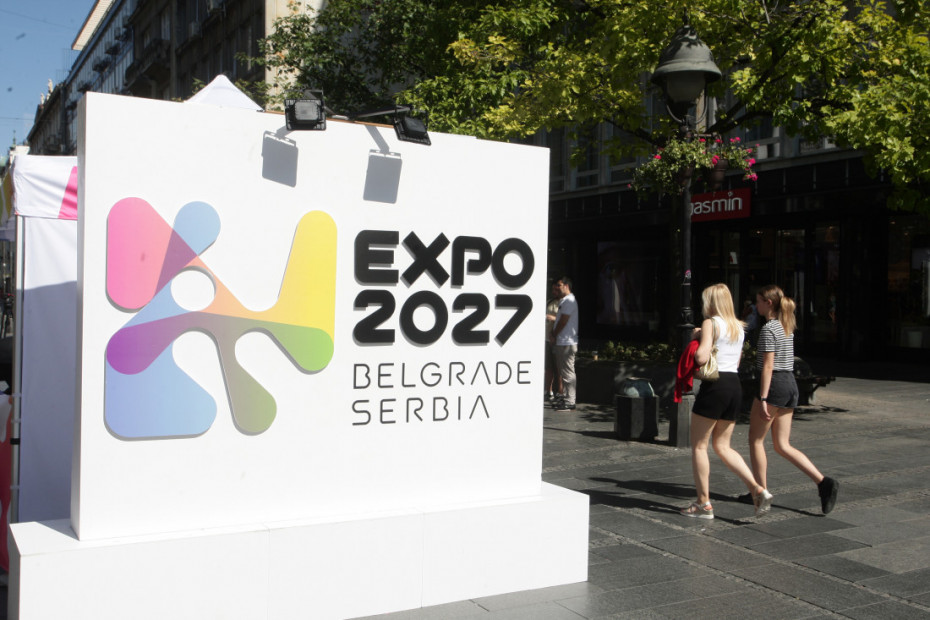
Expo will be held from May 15 to August 15, 2027. Its motto is Play for Humanity – Sport and Music for All. Expo 2027 in Belgrade is an international specialized exhibition recognized by the Bureau International des Expositions (BIE).
Such exhibitions are theme-oriented and are held between two world expos.
Unlike them, they are spatially limited: the exhibition area may cover no more than 25 hectares.
Four million visitors
Over three months, Belgrade is expected to become an international hub for culture, sport, technology, and the economy. For the government, Expo is a central modernization project. Construction of the complex alone costs around €1.2 to €1.5 billion; additional billions will be invested in the country’s broader development.
The exhibition is part of a wider plan. Around the site in Surcin, a new urban district is taking shape, with exhibition halls, congress centers, hotels, and recreational areas, which will continue to serve as a fairground and residential zone after the Expo. Infrastructure is being developed in parallel: new expressways, expansion of Nikola Tesla Airport, modernization of the railway network, a national stadium with 52,000 seats, and Belgrade’s first metro.
One of the key architects of this program is Sinisa Mali, Deputy Prime Minister and Minister of Finance. A former mayor of Belgrade and an economist who worked as an investment banker in the United States, he describes the coming years as a period of intensive investment.
"This is a leap into the future: €17.8 billion across 323 projects throughout Serbia. Roads, railways, schools, hospitals, kindergartens, energy, agriculture, and artificial intelligence. We are investing across the country, upgrading infrastructure, improving quality of life, and making Expo the biggest development opportunity for the entire country – and the region", Mali said.
Expectations are high: between three and four million visitors are anticipated, and more than one hundred countries will present themselves in their own pavilions. At a time of geopolitical tensions, observers also see diplomatic potential. At the opening in the Sava Center in Belgrade, representatives of various countries sit together – including Russia, Ukraine, Iran, and the United States. Perhaps not side by side, but at least in the same hall.
"This is the largest event in Serbia’s history. Every citizen will feel the benefits. The most important thing is the legacy: after the Expo, development continues. It is the foundation for accelerated growth from 2028 – through better relations with other countries, a positive image, and new economic momentum", Mali said.
A calling card of a multinational state
Serbia aims to leverage its traditional foreign policy role as a bridge between East and West. This stance, shaped by the Balkans’ history and complex international relations, is meant to present the country as a neutral host. Outside organizations such as the UN or NATO, talks could take place in a more informal setting.
This role has a long tradition. A visit to the Palace of Serbia, formerly the Palace of Yugoslavia, clearly demonstrates this. The building, constructed in 1961 under Josip Broz Tito, was conceived as a central venue for state receptions and international conferences – an architectural calling card of a country seeking to mediate between East and West.
In 1961, leaders of the Non-Aligned Movement met in Belgrade, including Tito, Egyptian President Gamal Abdel Nasser, and Indian Prime Minister Jawaharlal Nehru. The palace still serves for state visits, and President Aleksandar Vucic regularly uses it for meetings with foreign guests.
Economic positioning
Serbia also aims to reposition itself economically. The country’s economy amounts to around €84 billion, with growth of 2 to 4 percent in recent years. Mali expects higher rates:
"Next year we are planning GDP growth of 5 percent. After that, 4.5 to 5 percent. That is why we have presented Serbia 2030 and Serbia 2035 as a vision beyond Expo. Expo is an important turning point, but only a step toward long-term, sustainable growth", he said.
The labor market has improved significantly: unemployment has fallen from 25.9 percent (2012) to 8.7 percent today.
Foto: Tanjug/Sava Radovanović
Belgrade has been undergoing rapid transformation in recent years. Many parts of the city are being built and modernized, with the "Belgrade Waterfront" project particularly symbolizing this transformation.
An opportunity for Europe
Serbia remains committed to EU accession, although the process is progressing slowly. Mali emphasizes that Expo is also an opportunity for Europe to demonstrate its capacities in technology and artificial intelligence.
Even in the event of political changes, he believes Expo will not be jeopardized, as there is broad political consensus.
A melting pot of traditions
Expo could become a meeting place of diverse cultures. Organizers also expect visitors from the diaspora, including from the Balkans and Switzerland.
"It will be a melting pot of traditions and cultures from around the world – an opportunity for everyone to present their own identity", he said.
Until then, work in Surcin continues. The noise of machines fills the space, cranes rotate, and trucks deliver materials. Today, it is still a mix of dust, earth, concrete, and steel – but in a few months it is expected to become an international hub of encounters.
For Serbia, Expo is not just an exhibition – it is a political signal: that from a construction site, a rising country is taking shape.
Da li smrtna kazna donosi pravdu ili samo produbljuje spiralu nasilja? Dok broj pogubljenja u svetu značajno raste, a deo javnosti i u Srbiji traži vraćanje najstrože kazne posle brutalnih zločina, otvaramo pitanja granice između pravde, osvete i ljudskih prava. Da li strože kazne zaista znače sigurnije društvo ili je najveći test jednog društva način na koji kažnjava? Odgovore tražimo od advokatice Ane Selak.
specijal
22:00
INFORMATIVNA EMISIJA-PRESEK
Newsmax se bavi temama, a ne pukim prenošenjem informacija. Informišemo, ali želimo i da objasnimo, analiziramo, istražimo. Osvrnućemo se na izazove i prilike s kojima se suočavamo, analizirajući kako se aktuelna dešavanja reflektuju na naš svakodnevni život. Kroz razgovore sa stručnjacima i akterima iz različitih oblasti, pružićemo dublji uvid u važne teme koje se tiču politike, ekonomije, obrazovanja i društvene pravde. Pridružite nam se u ovoj analizi i saznajte više o pitanjima koja su važna za sve nas.
vesti
22:30
DOKUMENTARNI PROGRAM-NEWSMAX ORIGINALS
,,Newsmax Originals’’ je serijal koji donosi najvažnije priče i događaje iz savremene američke istorije, pružajući gledaocima jedinstven uvid u teme koje su oblikovale Sjedinjene Američke Države i njihov uticaj na svet.
dokumentarni
23:30
NEWSMAX USA-TOP STORY
Prikazuje karusel dnevnih objava i najnovijih vesti, sagledanih iz svih uglova. Spoj popularnih priča i najvažnijih vesti koje ostaju vidiljive danima, često inspirisana glavnim događajem dana ili nedelje.
Život Vasila Vida Pašanjskog promenio se iz korena nakon ujeda krpelja, koji je, kako tvrdi, doveo do ozbiljnih zdravstvenih komplikacija i dugotrajne borbe za dijagnozu.
Na zgradi Osnovne škole "Rastko Nemanjić – Sveti Sava" u Novoj Pazovi u ponedeljak ujutru osvanuli su grafiti uznemirujućeg sadržaja, zbog čega su među roditeljima tokom dana zavladali zabrinutost, pitanja i brojne reakcije.
Višem javnom tužilaštvu u Beogradu je iz Instituta za sudsku medicinu "Milovan Milovanović" dostavljen zapisnik o izvršenoj identifikaciji posmrtnih ostataka koji su pronađeni 21. maja 2026. godine u jednom buretu, koje je otkopano na teritoriji opštine Inđija.
The first president of the Democratic Party following the restoration of its activities, Dragoljub Micunovic, has died at the age of 95, the party announced.
President of Serbia Aleksandar Vucic stated in Beijing that he hopes some of the Chinese companies he invited during his visit to China to invest in Serbia will do so, assessing that such investments would significantly improve Serbia’s domestic capacities and economy.
Interior Minister Ivica Dacic stated that during the incidents following the May 23 gathering in Belgrade, 17 police officers were injured and 47 individuals were brought to Interior Ministry premises, including one person holding a diplomatic ID card.
Serbian President Aleksandar Vucic stated that the visit to China is of great importance for Serbia and expressed hope that more than 30 agreements and arrangements will be signed.
The Speaker of the National Assembly of Serbia, Ana Brnabic, stated that according to data from Eurostat, Serbia, together with Cyprus, was the fastest-growing economy in Europe in the first quarter of this year.
The President of Serbia, Aleksandar Vucic, speaking about the calling of snap parliamentary elections, told Radio Television of Serbia that they would be held sometime between September and November.
Serbian President Aleksandar Vucic held talks with Ukrainian Deputy Prime Minister Taras Kachka regarding a free trade agreement, stronger economic cooperation, and energy issues, emphasizing that there is significant room for expanding the partnership between the two countries.
European Commissioner for Enlargement Marta Kos assessed that the adoption of four electoral laws in the Serbian Parliament represents an important step toward free and fair elections, and announced continued cooperation with the authorities on the remaining reforms.
The President of the Republic of Serbia, Aleksandar Vucic, will pay an official visit to the People’s Republic of China from May 24th to 28th, according to a statement issued by the President’s Media Cooperation Office.















Komentari (0)